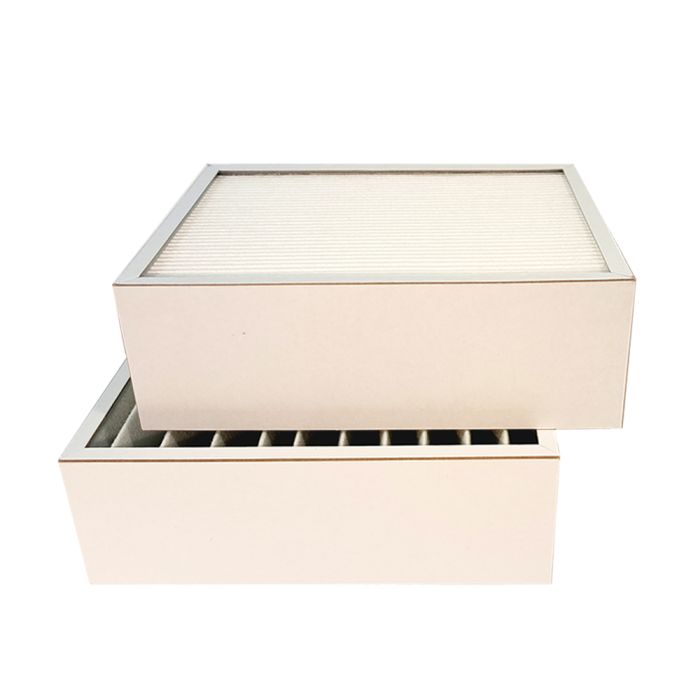
The ELITE 400 F7+M5 replacement filter provides efficient filtration with ePM1 55% and ePM10 60% performance, ensuring clean air for compatible models. Designed to fit dimensions of 290x220x96 mm, this minipleat panel filter offers a filter change interval of 6-12 months.
The ELITE 400 F7+M5 filterset offers high-efficiency filtration with an ISO 16890 classification of ePM1 55% and ePM10 60%, ensuring superior air quality for your environment. This replacement filter features a minipleat construction that maximizes surface area and enhances airflow, making it an ideal choice for maintaining optimal performance in compatible models like the ELITE 400.
ADVANTAGES OF FILTERS24:
Certified safety: Filters have passed tests according to REACH for over 250 harmful chemical substances.
Proven efficiency: Performance of filter verified in an independent laboratory according to ISO 16890 standard.
Free from carcinogens: Filters tested for TOF / PFAS particles and confirmed to be completely safe.
Filter material: Modern, synthetic two-layer filtering material which provides less air resistance (and therefore less energy consumption), high filtration efficiency levels (in the form of dust absorption), and a long filter life (involving low pressure drops).
Durable design: Built with a strong frame that resists deformation under challenging conditions. Material is glued to the frame and prevents air leakage.
Competitive pricing: Affordable rates and a large inventory of ready-to-ship filter sets.
Filter Classification by Particle Size
Filter Class
Particle Size Range
Typical Particles Captured
ISO Coarse (G3,G4)
>10 µm
Sand, fluff, flying seeds, fine hair, insects
ISO ePM10 (M5)
≤ 10 µm
Pollen, stone dust, agricultural dust
ISO ePM2.5 (F7)
≤ 2.5 µm
Bacteria, fungi, mold spores, fine pollen
ISO ePM1 (F7)
≤ 1 µm
Viruses and bacteria, nanoparticles, soot, sea salt, oil mist
WHY CHANGE FILTERS OVER TIME?
The producers recommend that filters be changes at least once or twice a year, at the beginning and end of the heating season. The interval also depends on the location and the intensity of ventilation.
Old and dirty filters lead to a pressure drop in the ventilation system and, as a result, the volume of fresh air inflow decreases, which worsens the indoor climate.
An old, dirty filter can contribute to the spread of mould in the ventilation system. (especially in humid climates), which can be a health hazard.
The new filter has the best air permeability levels and, as a result, savings can be made in electricity costs for the fan unit.
STORAGE AND DISPOSAL:
For long-term storage, keep in a dry place. Used filters can be disposed of with regular household waste.